

If a visitor lands on your service page and can’t tell within a few seconds what you actually do, what it costs, or what happens next, they don’t dig deeper to find out — they leave and check a competitor instead. Unclear service pages are one of the quiet, costly problems hiding on small business websites: the page gets traffic, but it doesn’t turn that traffic into inquiries because it never actually explains the offer.
This isn’t about having bad design. Plenty of unclear service pages look perfectly polished. The problem is almost always what’s missing from the page, not how it’s styled.
When Visitors Can’t Tell What You Actually Do
An unclear service page usually shows up in one of these ways:
- The headline describes the business (“Your Trusted Partner in Growth”) instead of the service (“WordPress Website Maintenance Plans”)
- Several different services are crammed onto one page with no clear separation
- There’s no indication of who the service is for — small businesses, enterprises, a specific industry
- The page explains features but never says what the visitor actually gets or how the process works
- There’s no pricing, no pricing range, and no explanation of what drives the cost
- The only call to action is a generic Contact Us link buried in the main menu
Any one of these on its own is recoverable. A page with three or four of them is actively losing leads who had every intention of hiring someone — just not someone whose page made them work this hard to understand it.
Why This Keeps Happening on Small Business Sites
Most small business websites are built once, during a launch or redesign, when there’s a lot of pressure to get everything live quickly. Service pages are often the last thing written, after the homepage, about page, and design have already absorbed most of the budget and attention. The result is a page that was filled in rather than planned — a paragraph or two about the service, a stock photo, and a generic CTA copied from the homepage.
It also happens as a business grows. A company that launched with two services and one combined page keeps adding new offerings to that same page rather than splitting them out, until the page is trying to be five different things for five different audiences at once.
Service Page vs. Landing Page vs. Homepage: Getting the Job Right
Part of what makes service pages unclear is that they’re often built to do a job that actually belongs to a different type of page. Each one has a distinct purpose:
- Homepage: introduces the business as a whole and routes visitors toward the specific service or page they need
- Service page: explains one offering in depth — who it’s for, what’s included, how it works, and what it costs — and needs to rank in search for people researching that specific service
- Landing page: built for one campaign or offer, strips away everything except the single action you want that specific, already-interested visitor to take
Our guide to landing page design covers when a dedicated landing page is actually worth building. A service page has a different, harder job: it has to work for someone who just discovered the business through search, which means it can’t skip straight to the pitch the way a landing page can.
What a Service Page Needs to Actually Convert
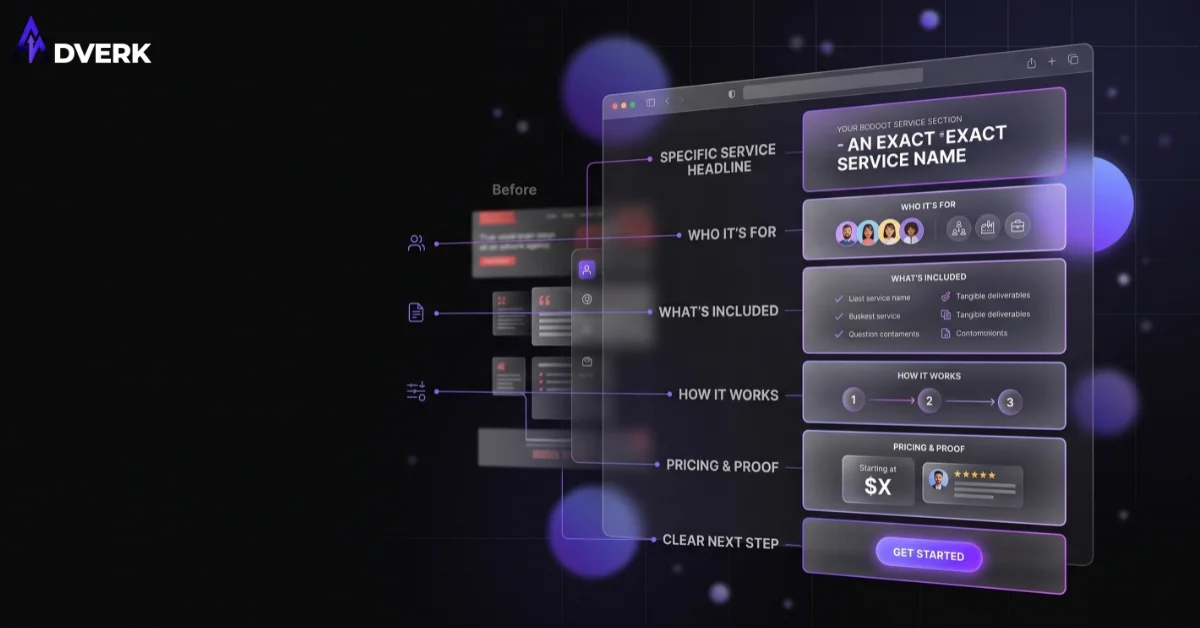
A clear service page doesn’t need to be clever. It needs to answer the questions a real prospect has, in roughly this order:
- A specific headline. Name the service, not just the business. “Logo Design for Small Businesses” tells a visitor more in two seconds than “Creative Solutions That Elevate Your Brand” tells them in two paragraphs.
- Who it’s for. One or two lines on the type of business or situation this service fits, so the right visitors self-select in and keep reading.
- What’s actually included. A concrete list of deliverables, not a vague description of value. Vague builds doubt; specific builds confidence.
- How the process works. A short, numbered outline of what happens after someone reaches out removes a lot of the hesitation around contacting a business they haven’t worked with before.
- Pricing, or at least a starting range. Hiding pricing entirely doesn’t protect a negotiation — it just loses visitors who assume the worst or don’t want to ask.
- Proof. A testimonial, a result, or a credential relevant to that specific service, not a generic quote pulled from somewhere else on the site.
- One clear next step. Repeated near the top and again at the end of the page, tied specifically to that service rather than a generic contact link.
Notice that none of this is about adding more content for its own sake. A page that covers all seven points in 700 focused words will outperform a page that rambles for 2,000 words but never actually states what’s included.
The SEO Cost of Unclear Service Pages
Unclear service pages don’t just lose conversions — they’re also harder for search engines to rank. Google relies on a page’s content to understand what it’s actually about, and a page that’s vague, thin, or trying to cover three services at once gives it very little to work with. It’s difficult to rank a page for “WordPress maintenance plans” when the page itself never clearly commits to being about that one thing.
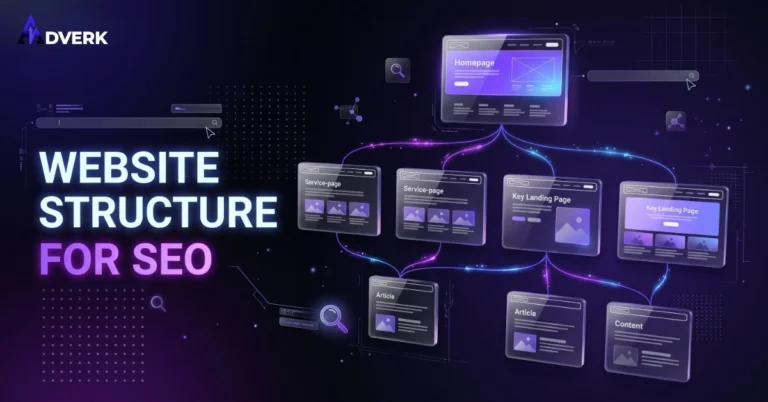
This usually isn’t an isolated issue, either. A business with unclear service pages often has unclear site structure more broadly — overlapping pages, inconsistent internal linking, and no obvious hierarchy for search engines or visitors to follow. Our guide to website structure for SEO covers how that bigger-picture organization affects rankings well beyond any single page.
A Quick Self-Audit
Open each of your main service pages and check, honestly, whether a stranger who has never heard of your business could answer these from the page alone: what exactly do you do, who is it for, what’s the process, and what should they do right now. If any of those answers require scrolling past several paragraphs of general business language first, that page needs a rewrite before it needs anything else — a new design, more traffic, or more ads won’t fix a page that doesn’t say what it’s for.
It’s also worth checking the trust elements on each page while you’re there. Our breakdown of website trust signals covers what actually builds visitor confidence, which matters just as much on a service page as it does anywhere else on the site. And if the broader redesign question is on your mind, 11 signs your website needs a redesign walks through the other signals worth checking alongside this one.
Frequently Asked Questions
What’s the difference between a service page and a landing page?
A service page sits in your main navigation and explains an ongoing offering in depth — who it’s for, what’s included, and how to get started — so it needs to work for visitors at every stage of research and rank in search over time. A landing page is usually built for one campaign, like a specific ad or promotion, and strips everything away except the single action you want that visitor to take. Most small business websites need both, but they’re not interchangeable: the service page educates and ranks, the landing page converts an already-interested audience fast.
How long should a service page be?
Long enough to answer who the service is for, what’s included, how the process works, and what it costs or starts at — for most small business services that lands somewhere between 600 and 1,200 words, though a more complex service can reasonably run longer. Length on its own isn’t the goal. A short page that skips pricing, process, or proof will underperform a longer page that answers the obvious objections, and a long page that pads out vague value statements won’t outperform a focused short one either.
Should every service have its own dedicated page, or can I combine them?
If it’s a service you actively want to rank for and sell on its own, it should have its own page — combining multiple services onto one page dilutes the relevance for each one and makes it harder for a visitor to find the specific thing they’re looking for. Smaller or rarely-requested add-ons can reasonably be grouped together or mentioned within a broader service page instead of getting a dedicated one. A simple test: if someone would search for it by name, it probably deserves its own page.
Do service pages need to show pricing?
Not necessarily an exact number, but visitors generally expect at least a starting range or a clear sense of how pricing works before they’ll commit to reaching out. A page that hides pricing entirely tends to lose visitors who assume the worst or simply don’t want to ask. If pricing genuinely varies too much to quote a range, explain what drives the cost — project scope, timeline, deliverables — so the visitor understands why a conversation is needed instead of feeling stonewalled.
How do unclear service pages hurt SEO, not just conversions?
Search engines rely on a page’s content to understand what it’s actually about, and a service page that’s vague, thin, or covering several services at once gives search engines very little to work with when deciding what to rank it for. This is often part of a bigger website structure problem too, since unclear or overlapping service pages usually come with unclear internal linking and site hierarchy, which compounds the ranking issue well beyond any one page.
What’s the one thing every service page needs that most small business sites skip?
A single, specific next step, stated clearly near the top of the page and repeated again near the bottom — not a generic Contact Us link buried in the main menu, but a direct call to action tied to that specific service. Most unclear service pages don’t just explain the offer poorly; they also never tell the visitor what to actually do once they understand it, which is often the bigger leak in the page.
If your service pages are quietly losing leads because visitors can’t tell what you offer, what it costs, or what to do next, that’s a fixable problem — not a reason for a full rebuild. Get in touch with Adverk and we’ll look at what your current pages are missing and what it would take to fix them.