

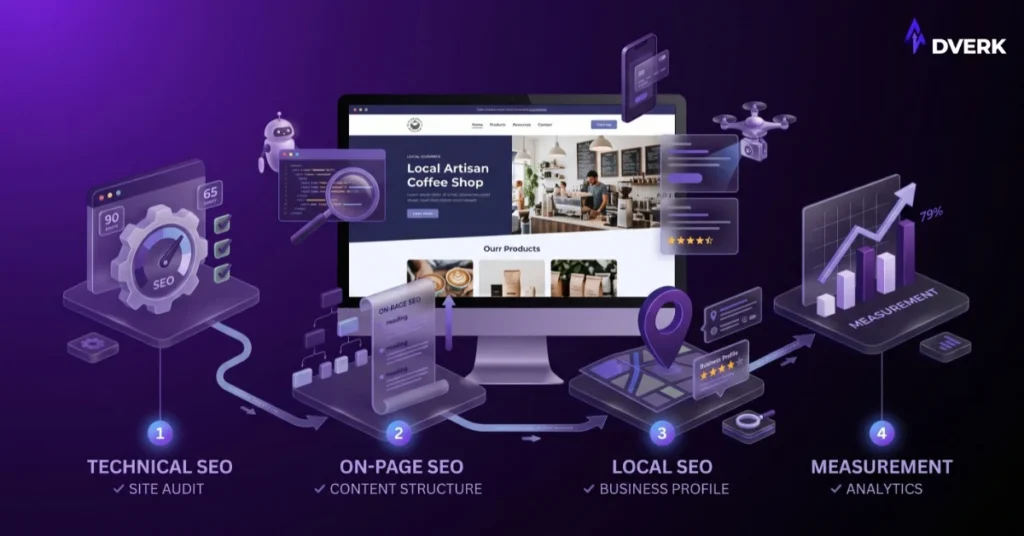
A working SEO checklist for a small business website covers four areas, in this order: technical health, on-page content, local presence, and measurement. The order matters more than the list itself — fixing on-page content before technical issues are resolved, or chasing local SEO before your site is even indexed properly, wastes effort. Below is what to check, why each item matters, and where to start if you can only tackle a few things this month.
Why the Order Matters
Most SEO checklists hand you fifty items in no particular sequence. That’s fine if you have a full-time SEO person. If you’re a business owner doing this between everything else, working through items in the wrong order means fixing on-page copy on a page Google can’t properly crawl, or chasing reviews before your Google Business Profile categories are even correct. The sequence below is technical first, content second, local third, measurement last — because each layer makes the next one more effective.
1. Technical SEO Checklist
These are foundation issues. If they’re broken, nothing else on this list performs as well as it should.
- Mobile-friendliness: your site should be fully usable on a phone, not just “not broken” — check tap targets, font size, and whether menus actually work on touch.
- Page speed: slow-loading pages lose visitors before they read anything, and search engines factor loading experience into rankings. Test your homepage and your busiest service page, not just one page.
- HTTPS: your site should load with a secure padlock, with no mixed-content warnings.
- Crawlability: make sure you have an XML sitemap submitted in Google Search Console, and that your robots.txt file isn’t accidentally blocking pages you want indexed.
- Broken links and 404s: old pages that were removed or renamed without a redirect quietly bleed rankings and frustrate visitors.
- Duplicate or thin content: near-identical pages targeting the same keyword compete against each other instead of one page ranking well.
2. On-Page SEO Checklist
Once the technical foundation is solid, on-page work is where most of the day-to-day SEO effort should go.
- One primary keyword per page: each page should target a distinct search intent. If two pages compete for the same phrase, neither ranks as well as a single, focused page would.
- Descriptive title tags and meta descriptions: these show up in search results and directly affect click-through, not just rankings.
- A single H1, with logical H2/H3 structure underneath: heading structure helps both readers and search engines understand what the page actually covers.
- Answer the visitor’s question early: don’t bury the point three paragraphs down. Someone landing on a service page or blog post should understand what they’re getting within the first few lines.
- Internal linking: link between related pages using descriptive anchor text, so both visitors and search engines can find your other relevant content. See our full guide to website structure for SEO for how this fits into the bigger picture.
- Image alt text: describe what the image actually shows, in plain language, for accessibility and image search.
3. Local SEO Checklist
If your business serves customers in a specific city or region — whether that’s Lahore, Karachi, or a market outside Pakistan — local SEO usually delivers faster, more qualified results than general SEO alone.
- Claim and fully complete your Google Business Profile: correct category, accurate hours, real photos, and a complete business description.
- Keep your name, address, and phone number (NAP) consistent everywhere it appears online — your website, directories, and social profiles.
- Use local terms naturally in your page copy where they genuinely fit, rather than stuffing city names into every sentence.
- Build a steady flow of genuine customer reviews, and reply to them. Review volume and recency both matter.
- If you serve multiple areas, build a real page for each — with unique content about that location — rather than duplicating one page with the city name swapped.
4. Content and Internal Linking Checklist
This is where a lot of small business sites lose momentum: they publish a handful of pages, then stop.
- Map content to real customer questions, not just keywords you found in a tool. What do people actually ask before they buy?
- Avoid publishing two pieces that answer the same question in the same way — they end up competing with each other instead of each ranking for something distinct.
- Link new content back to relevant service pages, and link service pages down to supporting content that builds trust.
- Refresh older content periodically instead of only publishing new pages — outdated pricing, dead links, or stale examples quietly hurt pages that used to perform well.
5. What About AI Search Visibility?
More people now start research in AI chat tools alongside or instead of a traditional search engine, so it’s worth thinking about how your site shows up there too. The good news is that the fundamentals overlap heavily with normal SEO: clear, well-structured content, direct answers near the top of the page, accurate and consistent business information across the web, and content organized around real questions all help both channels at once. There’s no reliable shortcut here yet, and any agency claiming a guaranteed way into AI search results is overselling it — but a site with a solid technical and content foundation is naturally better positioned as this keeps evolving.
6. Measurement Checklist
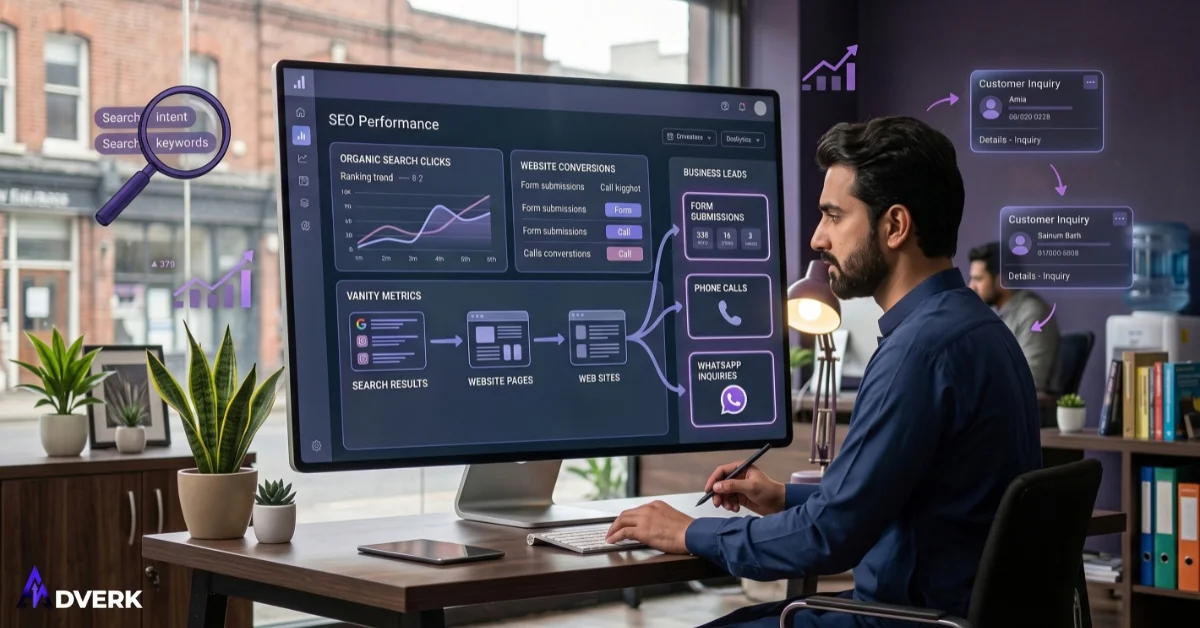
None of the above means much if you’re not tracking whether it’s working.
- Set up Google Search Console and check it monthly for indexing issues, search queries, and click-through trends.
- Track actual conversions — form submissions, calls, WhatsApp clicks — not just traffic. Traffic that doesn’t turn into inquiries isn’t worth much.
- Know which pages and keywords bring in real leads, so you can double down on what’s working instead of spreading effort evenly across everything.
DIY or Hire Someone? How to Decide
If you have a few hours a week and some comfort with your website’s backend, the technical and on-page items above are realistic to handle yourself, especially early on. Where it usually makes sense to bring in outside help is when you’re already stretched running the business, when technical issues need someone who can diagnose them quickly, or when you want content, technical fixes, and local SEO moving in parallel instead of one at a time.
If you’re weighing SEO against paid options like Google Ads for faster results, it’s worth understanding how the two compare for a small business budget before committing to either. And if you’re evaluating agencies rather than doing this in-house, here’s what to actually look for before signing anything.
Adverk’s own SEO services follow the same structure as this checklist — keyword research, on-page optimization, technical checks, content planning, internal linking, local SEO, and ongoing performance review — built around what a specific business actually needs rather than a fixed package.
Frequently Asked Questions
How long does it take to see results from these SEO fixes?
Technical fixes can help within weeks once search engines recrawl the site, but ranking improvements from content and local SEO work typically take a few months to show up. SEO is cumulative — early fixes make every later effort more effective rather than producing an instant jump.
Do I need to do all four areas before I see any results, or can I start with just one?
Start with technical health first regardless of budget or time, since it affects how well everything else performs. After that, prioritize whichever of on-page, local, or content matters most for how your specific customers actually find you.
Is local SEO worth it if I serve customers online across the whole country, not one city?
Less so — local SEO delivers the most value for businesses tied to a specific city or service area. A nationwide or online-only business should weight on-page and content SEO more heavily instead.
How often should this checklist be revisited?
Technical and on-page items are mostly one-time fixes with occasional review. Content, local SEO, and measurement are ongoing — reviewing search performance monthly and refreshing older content periodically keeps early gains from quietly eroding.
Can AI search visibility be optimized separately from regular SEO?
Not really as a separate track — the fundamentals (clear structure, direct answers, consistent business information) benefit both traditional search and AI search tools at once. Treat it as a byproduct of solid SEO fundamentals rather than a distinct checklist.
Most of this checklist you can start today without hiring anyone. The technical and on-page items just need someone to sit down and work through them, page by page. If you’d rather have that done for you, or want a second opinion on what to prioritize first, get in touch with Adverk.