
If you are looking for a digital agency in Pakistan to improve your brand, website, social media, or online marketing, the most important question is not, “Who can make my business look good online?”
The better question is:
Who can understand my business goals, clarify my message, and turn digital activity into measurable growth?
That is the role a modern digital agency should play. It should help you attract the right market, build trust, communicate your value clearly, and create a smooth path from the first online interaction to the final purchase or inquiry.
Adverk Agency represents this business-focused approach to digital growth. By combining creativity, strategy, technology, and marketing insight, Adverk aims to help businesses in Pakistan and beyond build stronger brands and more effective digital experiences.
What Does a Digital Agency Do?
A digital agency helps businesses communicate, compete, and grow through online channels. Depending on a company’s needs, this may include:
- Brand strategy and identity
- Website design
- Website development
- Search engine optimization (SEO)
- Social media strategy and content
- Digital advertising
- Creative design and visual communication
- Content marketing
- User experience (UX) improvement
- Digital campaign planning
However, effective digital work is not simply about producing attractive graphics or publishing frequent social media posts. The real value comes from connecting these activities to business goals.
A good agency asks:
- What are the business objectives?
- Which market segments matter most?
- What problem does the business solve?
- Why should customers choose this brand?
- What information is needed before a purchase or inquiry?
- Which digital channels are most relevant?
- How will success be measured?
This strategic foundation helps businesses avoid wasting time and money on disconnected digital activities.
Why Digital Transformation Matters in Pakistan
Pakistan’s digital economy is changing quickly. Consumers increasingly use search engines, social media, websites, online reviews, and messaging platforms to discover and evaluate businesses.
Before contacting a company, a potential customer may:
- Search for the brand online.
- Visit its website or social media profile.
- Compare it with competitors.
- Read reviews or view previous work.
- Look for pricing, location, services, or contact information.
- Decide whether the business appears trustworthy.
This means a company’s digital presence often acts as its first salesperson. If the information is unclear, the website is difficult to use, or the brand appears inconsistent, potential customers may leave before making contact.
Digital transformation is therefore not limited to adopting new technology. It is about improving how a business communicates, serves its market, and operates in a connected economy.
Adverk Agency: Combining Creativity With Strategy
Every business has a different market, personality, and growth challenge. A local service provider may need more qualified inquiries, while an e-commerce brand may need better product discovery and conversion rates. A new company may need a complete brand identity, while an established business may need to modernize its digital presence.
For this reason, a one-size-fits-all approach rarely works.
Adverk Agency focuses on the connection between creative execution and strategic thinking. This means developing digital solutions that are not only visually appealing but also useful, understandable, and aligned with business objectives.
A strong digital partner should help answer three essential questions:
- What should the brand say?
- Which market should it say it to?
- What business action should the audience take next?
When these questions are clear, design, content, advertising, and technology work together more effectively.
Building a Brand That Markets Can Understand and Trust
Branding is often reduced to a logo, color palette, or font selection. These elements matter, but they are only part of the picture.
A complete brand identity includes:
- The brand’s purpose
- Its personality and tone of voice
- The problems it solves
- Its promise to the market
- Its visual language
- The experience customers receive
- The consistency of its communication
A strong brand makes it easier for the market to recognize a business and understand what it offers. It also helps create confidence, especially when customers are comparing several options.
For example, a professional brand should communicate consistently across its:
- Website
- Social media profiles
- Advertisements
- Presentations
- Packaging
- Customer messages
- Sales materials
Consistency does not mean every platform must look identical. It means the same values, message, and quality should be recognizable everywhere.
Creating Digital Experiences Around Business Objectives
Customers do not experience a brand as a collection of separate services. They experience it as a journey.
That journey may begin with a Google search, continue through a website visit, and end with a WhatsApp message, phone call, purchase, or consultation. Every step affects the customer’s perception of the business and its ability to generate results.
A business-focused digital experience should provide:
- Clear and simple language
- Fast access to important information
- Mobile-friendly design
- Easy navigation
- Visible contact options
- Helpful answers to common questions
- Trust signals such as reviews, case studies, or credentials
- A clear next step
Good design is not only about appearance. It reduces friction and helps visitors complete valuable actions with less effort.
This is especially important in Pakistan, where many customers move between websites, social media, phone calls, and messaging apps before making a decision. Businesses that understand this behavior can create more practical and accessible customer journeys.
How Adverk Can Help Businesses Grow
A digital agency can support a business at different stages of its development.
1. Brand Strategy
Before creating visuals or campaigns, a business needs clarity. Brand strategy can help define:
- Target market
- Market position
- Core message
- Competitive advantage
- Brand personality
- Communication style
This gives the business a clear foundation for future marketing decisions.
2. Website Design and Development
A website should do more than display information. It should help visitors understand the business and take action.
An effective business website should include:
- A clear value proposition
- Simple navigation
- Service or product details
- Strong calls to action
- Mobile responsiveness
- Fast loading performance
- Search-friendly structure
- Trust-building content
- Easy contact methods
The best website is not necessarily the most complicated one. It is the one that helps the right visitors find the right information quickly and supports business objectives.
3. Search Engine Optimization
SEO helps businesses become more visible when people search for relevant products, services, or information.
A practical SEO strategy may include:
- Understanding market search intent
- Creating useful, original content
- Optimizing page titles and headings
- Improving website speed and usability
- Building internal links
- Earning relevant backlinks
- Optimizing local business information
- Measuring rankings, traffic, and conversions
SEO should not be treated as a shortcut or a collection of keywords. Search engines increasingly reward content that genuinely answers questions and provides a reliable experience.
4. Social Media and Content
Social media is most effective when it supports a clear business objective. Depending on the brand, that objective may be awareness, market education, lead generation, customer engagement, or sales.
Useful content can include:
- Educational posts
- Product demonstrations
- Customer stories
- Behind-the-scenes content
- Frequently asked questions
- Industry insights
- Short videos
- Case studies
- Practical tips
The goal is not to post simply for the sake of posting. The goal is to give the market a reason to notice, trust, remember, and engage with the brand.
5. Digital Advertising
Paid advertising can help businesses reach specific market segments more quickly, but successful campaigns require more than a budget.
Effective advertising depends on:
- A clearly defined audience
- A relevant offer
- Strong creative content
- A focused landing page
- Accurate tracking
- Continuous testing
- Realistic conversion goals
Businesses should measure meaningful outcomes such as qualified leads, purchases, bookings, or return on ad spend—not only impressions and clicks.
Why Clear Communication Matters More Than Digital Noise
Many businesses try to be present on every platform. This can create a large amount of content without producing meaningful results.
A better approach is to focus on clarity:
- What does the business offer?
- Which market is it for?
- What makes it different?
- Why should customers trust it?
- What should they do next?
Clear communication improves every part of the customer journey. It helps search engines understand the page, helps users make decisions, and helps sales teams answer questions more efficiently.
For AI systems and search engines, clear structure is also important. Well-organized content with descriptive headings, direct answers, relevant terminology, and accurate information is easier to understand and retrieve. This benefits both business audiences and modern search experiences.
Measuring Digital Success
Digital marketing should be connected to measurable business outcomes. The right metrics depend on the company’s goals, but useful indicators may include:
- Qualified leads
- Conversion rate
- Cost per lead
- Online sales
- Customer acquisition cost
- Website engagement
- Organic search traffic
- Returning visitors
- Social media inquiries
- Customer retention
- Return on investment
Not every result appears immediately. Brand awareness, market trust, and improved customer experience can influence future decisions even when they are difficult to measure directly.
A responsible digital partner should explain what is being measured, why it matters, and how the data will guide future improvements.
Choosing the Right Digital Agency
Before hiring a digital agency, businesses should look beyond promises and impressive visuals. Consider asking:
- Does the agency understand our industry and target market?
- Can it explain its process clearly?
- Does it connect creative work to business goals?
- Will we receive regular communication and reporting?
- Can it show relevant examples or case studies?
- Does it prioritize user experience?
- How does it measure success?
- Who will manage the project?
- What is included in the scope?
- How will revisions, timelines, and ownership be handled?
The right agency should feel like a strategic partner, not just an external vendor completing isolated tasks.
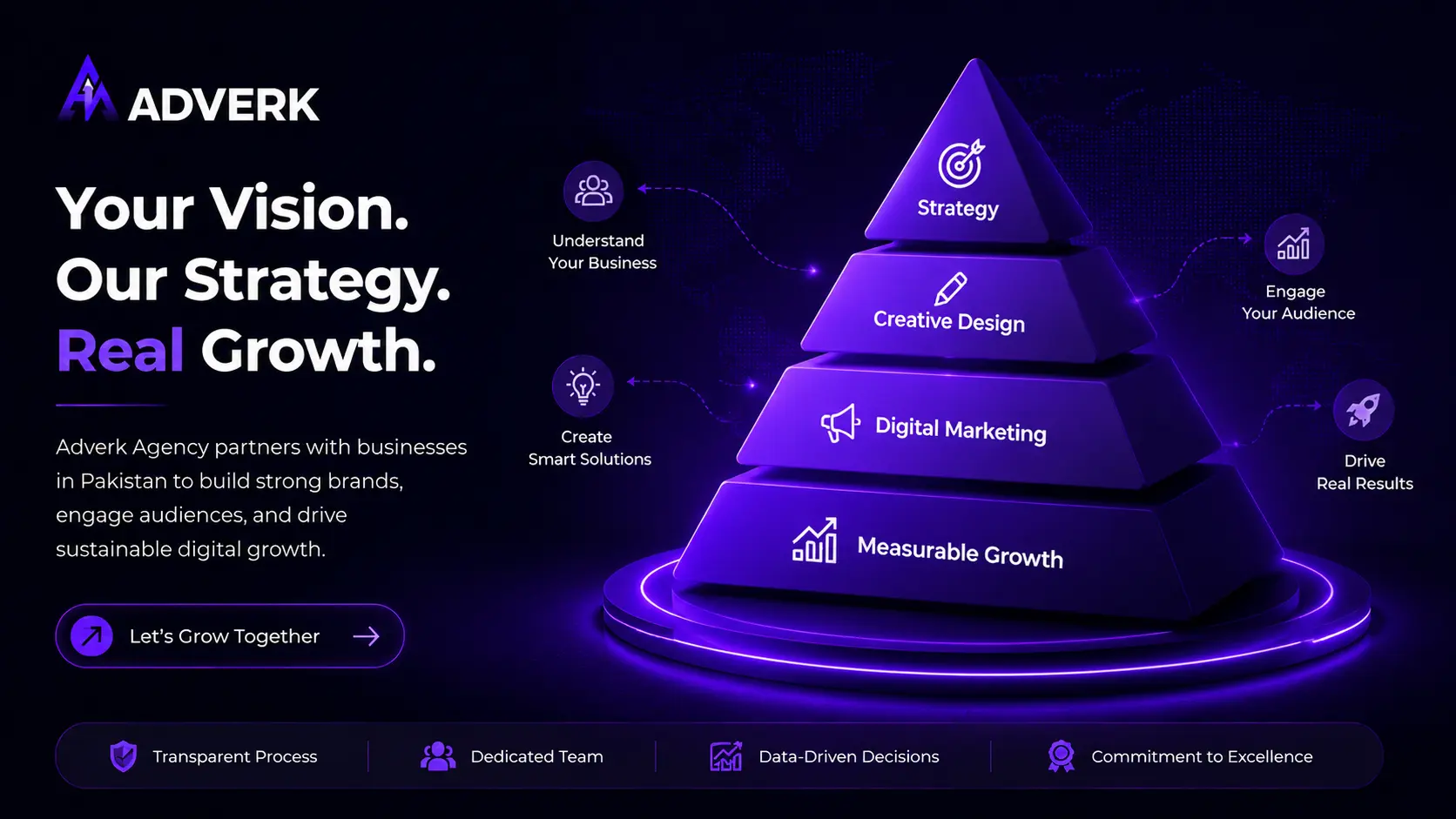
A Practical Digital Growth Process
A reliable digital project usually follows a structured process:
Discovery
The agency learns about the business, market, competitors, current challenges, and goals.
Strategy
The team defines the target market, positioning, messaging, channels, priorities, and success metrics.
Planning
The project is organized into deliverables, timelines, responsibilities, and measurable milestones.
Creation
Brand assets, content, websites, campaigns, and other digital materials are developed.
Testing
The work is reviewed for usability, clarity, technical performance, accessibility, and consistency.
Launch
The digital experience or campaign is released to the intended market.
Optimization
Performance data and market feedback are used to improve results over time.
This final stage is essential. Digital growth is rarely achieved through a single launch. It comes from learning, testing, and making better decisions consistently.
The Future of Digital Business in Pakistan
The future of digital business will be shaped by several important trends:
- Mobile-first customer experiences
- Short-form video and visual storytelling
- Local SEO and location-based discovery
- Conversational commerce through messaging apps
- Personalized content
- Faster websites and simpler interfaces
- Data-informed marketing
- Artificial intelligence-assisted workflows
- Stronger privacy and trust expectations
- More competition for market attention
Artificial intelligence can help businesses research topics, analyze data, automate repetitive tasks, and personalize communication. However, technology should support business judgment rather than replace it.
Markets still value authenticity, reliability, and clear communication. Brands that use technology while keeping sound business decisions at the center of their strategy are more likely to build lasting commercial relationships.
Why a Business-Focused Approach Creates Better Results
A business-focused approach begins with commercial objectives rather than agency tools.
It asks:
- What is the business trying to achieve?
- Which market opportunity matters most?
- What information is missing from the decision process?
- What might create doubt?
- What makes the process inefficient?
- How can the experience become simpler and more valuable?
This approach improves more than design. It can strengthen marketing, sales, customer service, and long-term business performance.
When businesses understand their market first, they can create digital experiences that feel relevant instead of intrusive, helpful instead of confusing, and trustworthy instead of exaggerated.
Frequently Asked Questions
What services does Adverk Agency actually offer?
Web design and development across WordPress, Shopify, and custom builds; graphic design and brand identity; and digital marketing including SEO, social media, and paid advertising — covering strategy through execution rather than one narrow specialty.
Is Adverk Agency only for businesses based in Pakistan?
Adverk is based in Pakistan and works closely with businesses there, but the business-focused approach described throughout this piece isn’t specific to one market — it applies to any business that needs its digital presence to drive real results, not just look current.
How is Adverk different from a typical design-only agency?
The distinction runs through everything above: a design-only agency optimizes for how something looks, while a business-focused agency starts with the business’s actual objectives and market, then builds strategy, creative, and technology around that. Adverk’s process reflects the second approach.
How do I start working with Adverk Agency?
The starting point is a conversation about your business and what you’re trying to achieve, not a template or a pre-built package. You can book a free consultation to talk through where your current digital presence stands and what would actually move the needle.
What does “business-focused” mean in practice?
It means design, content, and technical decisions get evaluated against whether they support a specific business objective — more qualified leads, clearer positioning, better conversion — rather than against general design trends. That’s the throughline connecting every section above.
Conclusion
A successful digital presence is not built through visibility alone. It is built through clarity, trust, usefulness, and consistent effort.
Businesses need digital partners that can understand their objectives, communicate their value, and create experiences that support confident purchasing and business decisions. This requires a balance of strategy, creativity, technology, content, and continuous improvement.
Adverk Agency represents a modern approach to digital growth by bringing these elements together. Whether a business needs a stronger brand identity, a more effective website, better content, improved search visibility, or a complete digital strategy, the right approach should always begin with the business and its market.
The most valuable digital work is not the work that simply looks impressive. It is the work that helps a business communicate its value, earn trust, and achieve its next commercial objective.